
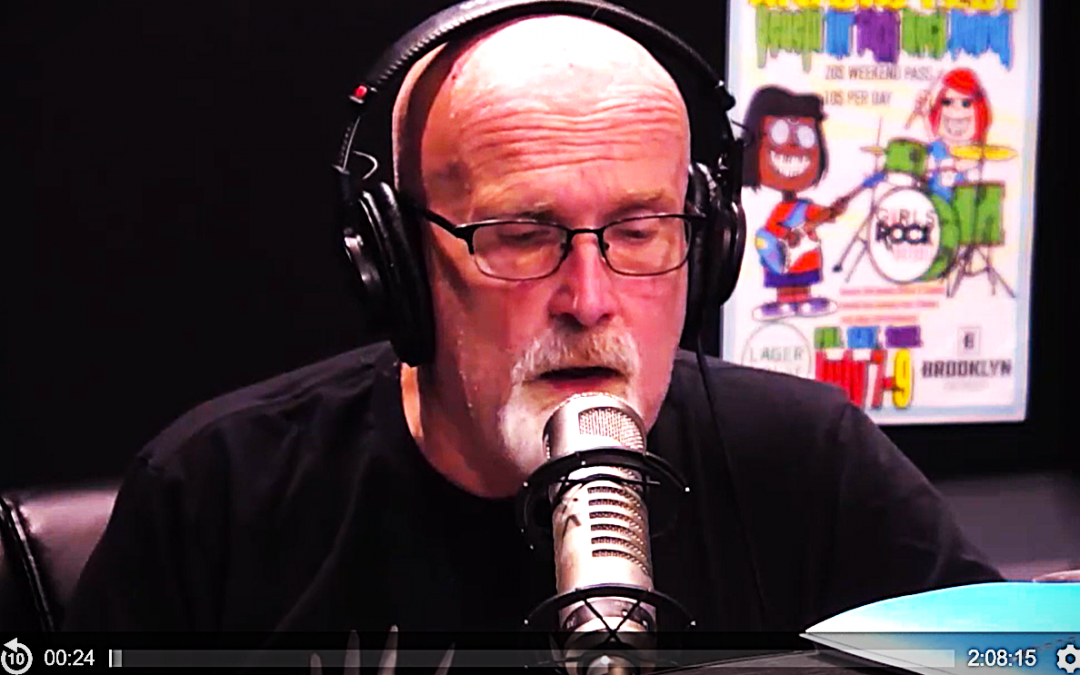
THE BUSY WORLD OF SCOTT BOATRIGHT
Ever hear of the Corktown Music Festival? 11 Mile Sessions? Henry Ford College Radio? What do they have in common? Scott Boatright is a key player in all of them. Rock in Detroit recently spoke to Scott about his involvement in the Detroit rock scene.
ROCK IN DETROIT: You have a good claim to be among the leading impresarios of the Detroit rock scene. You are the person behind the 11 Mile Session podcast and the Corktown Music Festival. These, I’m sure, keep you busy. Have I missed anything?
SCOTT: As far as events happening currently, that pretty much covers it. 11 Mile Sessions Live is a weekly thing. The Corktown Music Festival is an annual charity event that takes months to prepare, which keeps me occupied from November until the end of April.
ROCK IN DETROIT: How did you get started in all of this? Do you have roots in Detroit rock and roll or are you a transplant?
SCOTT: I was born and raised in Detroit and have lived in the area ever since. I have never performed live or been in a band, but I have attended national and local concerts since 1977. I really became a part of the local music scene in the late 90s when I became a DJ at WHFR, Henry Ford College Radio.
ROCK IN DETROIT: I was just looking at Henry Ford College Radio, (89.3 FM). They have some awesome shows. What was your show called and what did you play?
SCOTT: That’s a very loaded question. Between 1998 and this year, there are many of them. My first one was Interstellar Overdrive (from the Pink Floyd song)–Classic and Modern Psychedelic/Space Rock. The second one was Bipolar Transmissions–a mixture of space rock/ambient and dark alternative. Other Dimensions in Music–Modern Classical and Musique Concrete. Sounds from the Corridor–Ambient/Experimental, and Brain Ticket Death–Noise/Musique Concrete (both from 1999-2005 and 2013-2020). Motor Live Drive at 5, which became Live from Studio J, from 2013 until the Covid shutdown, which was the same format as 11 Mile–audio only with my same engineer Alan Contino. Finally, from October until just recently, Cold Radio Fusion, different each week of the month. First, a reboot of Sounds from the Corridor; second, Metal of all kinds (classic, death, black, etc.); third, Goth/Industrial/Dark Electronic; fourth, Stoner/Psych rock; and if there is a fifth one, Noise. I am taking a breather right now from that.
ROCK IN DETROIT: Tell us about 11 Mile Sessions. What is it? What’s the format? What was the idea behind it?
SCOTT: 11 Mile Sessions Live is a Streamcast, that word being copyrighted by the company I work with, NRM Streamcast. It is streamed live every Thursday except holidays, and then is available on 25 different channels on demand, including Apple, Spotify, Pandora, Fire, Roku, and more. The first hour I usually play select videos from bands/acts that are performing that weekend, sometimes I have in-person interviews with local artists, and occasionally pre-recorded zoom-like interviews with national artists coming to town to play. In the second hour, I host live performances/interviews of bands/acts of all genres. They play approximately 45 minutes of music, in between songs we discuss their bio, releases, upcoming shows, and anything else they wish to promote. The idea is to promote local artists by having them perform their original material, and at the same time, offering them a free live studio recording, where they can utilize it as they wish (demo, live recording release, etc.).
ROCK IN DETROIT: About how many bands have you had on 11 Mile? Your show seems proof that Detroit rock is alive and thriving. Looking over your episodes, it seems just about everyone has played–it’s almost a rite of passage. How do you select who will be featured?
SCOTT: I couldn’t say an exact number, but as I write this, I am preparing for episode 163, and there have been some shows where more than one act has performed, so close to 200 would be my guess. The selection process is pretty simple. Most bands approach me, due to word of mouth, or referral by other promoters and bookers. Occasionally I have open slots, and a simple post on social media will usually help me fill those.
ROCK IN DETROIT: What would the best way be for a band interested in performing on 11 Mile Sessions to contact you?
SCOTT: Info@11milesessionslive.com, or find me on FB, I am pretty approachable.
ROCK IN DETROIT: Some tapings, I imagine, go better than others. Without necessarily identifying anybody, could you tell us about a taping that didn’t go so well? Or any particularly memorable session?
SCOTT: Even though the show is taped, it is still live, and there are no redos. Everyone is human, so mistakes are made, even by me, but I don’t feel I have ever had a show that went poorly enough to keep in memory. I have always kept my show informal, and never strived for perfection for the band or myself, which keeps everyone involved at ease. I have many memorable sessions, some of them where a band exceeded my expectations of them or where there is really good chemistry concerning our dialogue.
ROCK IN DETROIT: What’s your favorite part of 11 Mile Sessions?
SCOTT: Hands down, seeing the artists enjoying themselves, performing without any distractions, and feeling good about what they are doing.
ROCK IN DETROIT: It’s a really nice setting to perform in. You can often hear yourself much better than when playing before a crowd. And the sound quality is excellent. Who is your engineer and what is his background?
SCOTT: Alan Contino. He has been doing this since adolescence. He was helping out with sound and audio regarding TV Cable for Henry Ford College before he was finished with High School. He has several degrees in sound engineering and physics, film production, and has his own film company, Delirium Films. He designed and built the 11 Mile studio we are in, as well as others in the past and present. He has also done sound/visual for some of the large venues in the area, including The Palace and Pontiac Silverdome, and as part of the crew for ESPN events out of state.
ROCK IN DETROIT: Tell us about the Corktown Music Festival. When is it scheduled for? What is your role? For how long have you been involved?
SCOTT: Next year April 23rd through the 25th, 2026. I created the Corktown Music Festival in the fall of 2021, the first one happening on the first weekend of March, 2022. I am the main booker, planner, and organizer. I have a small group of people that help me each year, and the roster changes often. I formed a nonprofit in October of 2022, SB Music Alliance Group, in order to have tax exempt status and to seek grants and sponsorships for the festival. That is still being worked on. I have had several members as part of this group. It varies from year to year.
ROCK IN DETROIT: What sort of musical acts will be featured? Do you plan to emphasize any particular genre or subgenre of rock music? What types of music will be featured besides rock?
SCOTT: The festival always includes solo artists, duos, and bands of all sizes. Normally the festival includes all types of rock (classic, punk, garage, rockabilly, ska, alternative, goth, etc.), as well as Americana, blues, jazz, funk, metal, electronic, hip hop, experimental, and whatever else comes our way that might be interesting.
ROCK IN DETROIT: For 2026, you will be donating proceeds Passenger Recovery, a Detroit-based recovery support system. How did you hook up with them? Have you donated to other groups in the past?
SCOTT: I was already familiar with them from other benefits in the past organized by others in the music community. The first few festivals were donated to 4 Paws,1 Heart, a non-profit animal rescue and home placement organization. In 2023, the charity was Girls Rock Detroit, an organization providing young females with summer camp for musical instruction and self-esteem support. In 2024, the charity was the United Cerebral Palsy Organization.
ROCK IN DETROIT: Do you have any personal favorite local bands? What local bands do you feel have a best chance, or some chance, at making it big?
SCOTT: Those are tough questions. As far as personal favorite bands, the list would be large, and I am always afraid of leaving someone out, so I will pass on that. And as to someone making it big, the industry is harder than it’s ever been, and it would have to be someone that worked extremely hard, did not give up, and was very lucky at the same time.
ROCK IN DETROIT: Here’s another tough question for you. Based on your experience in the music scene, what is the path for a rock band to make it? One day they are playing Old Miami and giving a great performance of 11 Mile Sessions, and one day they are playing the Majestic and similar venues across the country. How do they get from one stage, so to speak, to another?
SCOTT: That is a tough question. My greatest advice is be prepared to make it a full time commitment, like owning your own business, and be dependable, punctual, and flexible with your performances. While you should be able to rely on venues for promotion, you are the one most responsible for that. Finally, even the greatest bands have performed for an empty room, as well as a packed house. You give it your all no matter what.
ROCK IN DETROIT: What’s next? Do you have any projects on the horizon? Or beyond the horizon?
SCOTT: Currently, I have nothing on the horizon. But I am always open to new projects if they come my way.
ROCK IN DETROIT: How about starting your own record label, 11 Mile Records? Or starting your own band?
SCOTT: There are no plans for a 11 Mile label. We provide the session as a free in studio recording for the artist to do what they wish with it as long as we receive credit for it. I really don’t believe I will ever have time to be in my own band and am no longer able to play due to hand issues (nothing serious). I am kept busy enough with 11 Mile and can do shows whenever I like at WHFR, so I am pretty content with that.
ROCK IN DETROIT: All’s right with Boatright!
Recent Comments