
ROCK IN DETROIT’S
SEPTEMBER 2026
BAND OF THE MONTH:
CINECYDE
Cinecyde. Perhaps Detroit’s longest running and most productive, dedicated and creative punk/pop/garage outfit. What got them started? What keeps them going? Where/when can you catch them? Rock in Detroit recent spoke to lead vocalist and frontman extraordinare Gary Reichel.
ROCK IN DETROIT: Let’s start with some numbers. When was Cinecyde formed? How many members has it had over the years? How many shows do you think you’ve done? How many releases have you had?
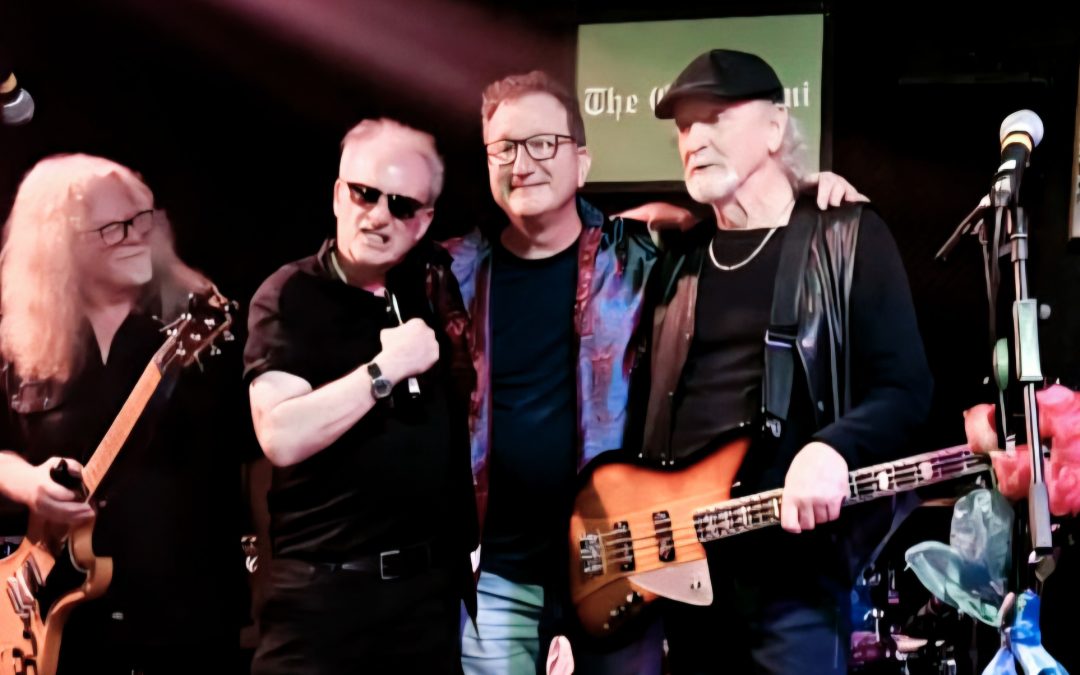
GARY: We formed in 1976. Fourteen people in a four-man band. Jim Olenski (Guitar) and I are constants. Three bass players in all that time. Clay Albertson to start off. Chris Girard was bassist from 1980 to 2018 or so, until his passing. Skid Marx (Flirt, The Seatbelts, Circus Boy and more) joined as Chris’ health declined. Skid, I might add, is a good guy to collaborate with on songs. Rodger Wesch drummed from the beginning to 1989. Most of the change-overs were drummers in the 1990s. We had Bootsey X for a bit! Changing drummers was difficult as every change-over is like starting over. Diane Schroeder came onboard as drummer in 1999 and stayed with us until her passing in Feb 2026. Dan Allen (Junk Monkeys, Media Panic) took Diane’s place. Dan is respectful of what Diane contributed with all the songs and frequently picks up on her cues.
How many shows? I would figure over 400 shows. How many releases? I wish there were more! Sixteen Cinecyde releases (not including re-issues in Europe), plus numerous appearances on compilations. Also a handful of bootlegs. And I’ll announce here, a new single “Nutzo-Ology” will be out before the end of the year.
ROCK IN DETROIT: 1976–wow! That’s the year the first Ramones album was released. Did it have any influence on you? What were you listening to then?
GARY: It was a load of fun to hear the Ramones album! Rock ‘n’ roll had over the previous eight years become not very satisfying. I was listening to the garage bands of the sixties, The Stooges (considered outcasts in that time), Roxy Music, old blues, rockabilly. Going to record conventions, I found these obscure bands that would issue their own records! Many times they were influenced by the mid-sixties, they were going their own way in spite of what the contemporary rock sound was. So, by the time Ramones came out, it was great, cool and fun, but we were all ready and waiting for this.
ROCK IN DETROIT: Do you think you hold the title of longest continually playing local Detroit rock band? Any other contenders?
GARY: I think that’s true. The Seatbelts, 3-D Invisibles.
ROCK IN DETROIT: What do you credit Cinecyde’s longevity to?
GARY: Keeping it fresh. Working on new material. Open to other members’ ideas. Everyone has to have a stake or at least making it worthwhile to show up. And those songs better be compelling.
ROCK IN DETROIT: But that raises the question: How can you write compelling songs for so long? Do you ever feel like you’re running out of riffs or topics to sing about?
GARY: I don’t know, it just happens. I mean, you have to be open to creating and working a bit to give it a unique lyrical and musical spin. Anyway, the ideas keep pouring out! Running out of ideas? It makes me think of the Marlon Brando character in The Wild Ones. A girl says to him, “What are you rebelling against, Johnny?” He says, “I don’t know, whadda you got?”
ROCK IN DETROIT: You’ve probably seen a lot of local bands come and go over the years. Do any stand out for you as bands that deserve to be remembered?
GARY: I’ve always loved The Ramrods, The 27, Hysteric Narcotics, 3-D Invisibles, The Boners, Dirtbombs, The Volcanoes, Bill Bondsmen, Sleep, L7, Bootsey X, Norcos Y Horchata, The Zotz. I genuinely enjoy what you do; Hydrogen Jukebox, The Subsets. The reality is, I’d have a hard time listing all the bands I’ve enjoyed and think they should continue to be heard. That’s really what pushed me to put together six compilations albums of Detroit music from 1980-1993. My fandom!
ROCK IN DETROIT: I didn’t know about those. Where are they available?
GARY: The compilations were Detroit Defaces The Eighties (1980) lp, Mandatory Music (1981) lp, When Monkeys Were Gods (1985) lp, End of the World A Go-Go (1986) lp, Folk Songs from the Twilight Zone (1988) lp, Detroit 1999: The Big Ugly (1993) cd. You might find some around town, but I sell them on eBay. And, oh the stories in putting these discs together!
ROCK IN DETROIT: How would you say Cinecyde’s music has developed over the years? Some have said it’s moved from more on the punk side to more on the power pop side.
GARY: That’s funny. I thought we’ve gone more to the punk side in the last few years. Those first releases were pretty in your face. But at the same time, we had Tough Girls (Bebe Beull covered it and her version was produced by Rick Ocasek), leaning toward a power pop song. Jim and I have been influenced by a lot of the pre-punk sources, but also the garage-rock of the mid-sixties, which give a pop sensibility to the music along with the toughness. But we mine the spectrum of sound while keeping it our own sound.
ROCK IN DETROIT: Tough Girls is a great track. Simple, melodic, mid-tempo, well-crafted. Not surprised it was picked up. Great example of what punk-pop should be (as opposed to Green Day!). Tight harmonies. Did you produce it? Where did you record it?
GARY: Thank you, Sir! Yes, we recorded it ourselves on (at the time) a newly acquired Otari eight-track machine. Our drummer, Rodger Wesch really took to it and gave us a great sound. Right after that, we started working on our album, I Left My Heart In Detroit City. We recorded it in his basement of a house in Royal Oak on Etowah Street. The home was later taken by the State of Michigan to make way for I-696.
ROCK IN DETROIT: In your estimation, how has the local rock scene (clubs, audience, bands, music) changed since you started out?
GARY: That early scene (1977-80) was a lot of fun and very eclectic. A spectrum of sound that had pretty good audience support. It can be fun to see bands, but it is more fragmented now.
ROCK IN DETROIT: Any thoughts about why? Do you think it may have to do with age diversification (people playing rock go from 20s to 70s these days) or music diversification (over the last 50 years so many genres of rock have developed, from ambient to death metal)?
GARY: There were fewer scenes back then, so it was all more focused. Various waves came through over time, after the garage scene of the 1990’s, it seemed more splintered. Not criticizing.
ROCK IN DETROIT: OK, time to ask the inevitable question: How did Cinecyde get its name? What does it mean? (Death of film?)
GARY: Very good! I looked at it as a variation of film noir. I enjoy that film genre quite a bit. The desperation, a good man left with bad choices, the femme fatales. Some of our more recent songs that play on that theme are Out of The Past and Primitive Town.
ROCK IN DETROIT: That’s interesting. A lot of bands seem to have been inspired by horror, monster and science fiction films. Film noir not so much. (Touch of Evil has a great rocking Mancini soundtrack.) But speaking of music, could you identify one cut of Cinecyde that you’d who like readers to check out to get a sense of your music? Why that one?
GARY: No. That’s a lot of music to look at. Here are some. Better Dead, a disillusionment with the city and hard advice for dealing with it. Sugar Buzz, the other side of Cinecyde with a bright and hopeful outlook, cited by WDET as one of the best of the year. Don’t Push Me, a fun punk-rockin’ tune!
Touch Of Evil, oh yeah! Great one! Kind of the end of film noir period. One more thing I could mention, is Jim Olenski and I have always had an appreciation for movie soundtracks. So along with all the rock n roll, goes a dose of Ennio Marricone, Bernard Herrmann, Henry Mancini and so many more.
ROCK IN DETROIT: How about lyrics? Where do you get your lyrical ideas from?
GARY: I don’t know. I can start with music and then do lyrics or start with a title and lyric idea and fit it to music. The lyric ideas, there’s no predicting. I try to be semi-aware during the day. I might hear a word that sticks with me and then becomes an idea. Some of this has to do with entertaining myself. Working physically; building, digging, tearing things apart can boost lyrical and melody ideas. I want them to be worth listening to, so you have to be more selective in what is included in a song.
ROCK IN DETROIT: How about you new single Nutzo-Ology. Where did the idea for that come from?
GARY: The title is me riffing with a student of psychology, goofing around with college class titles. But from there reflecting on my observations of too many meds.
ROCK IN DETROIT: Cinecyde recent lost a member. Did you consider calling it quits for the band? Do you think you’ll ever call it quits?
GARY: Our Sweet Diane Schroeder left us several months ago. She drummed with us since 1999, but there wasn’t an idea of stopping. We miss her deeply. We have a lot of music to give and create. No plans to stop. The future will always have something to give that must be handled or dealt with.
ROCK IN DETROIT: So what do you think you might have to handle or deal with?
GARY: I don’t know, whadda you got?
Cinecyde will be performing at Trixie’s Bar on September 18, 2026
We appreciate the attention, Tony! Thanks!