
ROCK IN DETROIT’S
OCTOBER 2026
ARTIST OF THE MONTH:
MATTHEW SMITH
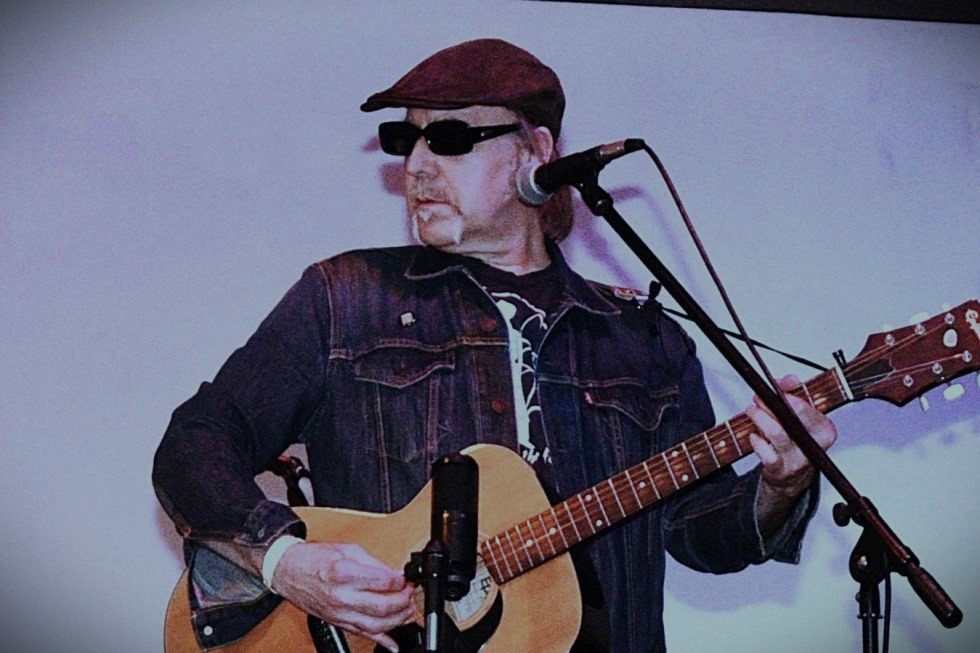
Singer, songwriter, producer, and veteran of such legendary Detroit bands as Outrageous Cherry, The Witches, and The Volebeats, Matthew Smith has recently taken the helm in the eponymous Matthew Smith Group. After a magnificent performance closing out the Hamtramck Labor Day Festival, Matthew spoke to Rock in Detroit.
ROCK IN DETROIT: Let’s start at the beginning. What’s your earliest musical memory?
MATTHEW: Earliest is hard to pinpoint, but “Mickey’s Monkey” by the Miracles was a big deal. “This cat named Mickey came from out of town”–great lyrics. You could visualize Mickey coming to town, doing the Monkey, etc., and it all seemed like real serious stuff.
ROCK IN DETROIT: Yeah, “He was spreadin’ a new dance all around.” That was when rock was dance music. I’ve always loved that era of rock. Do you think there’s still room for rock to be dance music?
MATTHEW: I think so, but someone will probably have to take away their cell phones first!
ROCK IN DETROIT: So speaking about kids–with or without cell phones–psychology says our personalities are fixed by age 15. At 15, who was your favorite musical group? Would you say that sound still moves you and that you incorporate it in your current music?
MATTHEW: I listened to everything on the radio back then, but by age 15, I’d discovered the Velvet Underground, Can, Captain Beefheart, Pere Ubu and that whole cosmology that wasn’t played on the radio. I was already into Sparks, Mountain, Moody Blues, Procol Harum, and basically anything interesting that I could find cheap in the cut-out bins of drugstores and department stores. I eventually started hanging around musicians who regarded the first three Wire albums as the most important music ever. Wire’s “154” album kind of changed the world, I think. My favorites are still Roxy Music and Soft Machine and all of their various side projects.
ROCK IN DETROIT: Man, you were quite precocious! I didn’t learn about most of those bands until college. Love Velvets, Roxy, Pere Ubu and Procol Harum. Hate to ask another retro question, but do you think that was the golden age of rock?
MATTHEW: Yes. Rock albums were made with a different mentality back then. I think the idea of “indie rock” amounted to an avoidance of the old methods. It’s like music was evolving through the years, then suddenly digital technology came along and by the early 80s everyone threw all the great analog technology in the garbage and everyone started using digital equipment all at the same time, without taking the time to figure out what sounded good or bad, and then by the 90s, records weren’t capturing the same energy and feeling as before and there were more options to “fix things,” and less spontaneity. So nowadays it would be hard for anyone to make a record as good as “Louie Louie” by the Kingsmen because everyone knows too much and doesn’t know enough, simultaneously.
My approach to the studio is to try to pick up from where the evolution of recorded music came to a halt, and work from there. I’ve known a lot of producers who worked in the 50s, 60s and 70s, and they all encouraged me and taught me things. A typical conversation with Andre Williams might start with “Ike Turner told ME, and now I’m telling YOU . . . .”
ROCK IN DETROIT: You’ve played with some well-known bands–Outrageous Cherry, The Volebeats, The Witches–and some less well-known ones–THTX and Crime & the City Solution. What was your first band experience? Did you ever play in an actual garage?
MATTHEW: First band experience was a basement in Warren, Michigan around 1978. I found myself singing and playing guitar with Mike Alonso on drums, Troy Gregory on bass, and John Helvey also playing guitar. We were kids playing cover tunes. It would take another 10 years of playing with a lot of different people before I felt I was making music that was as good as the records I listened to.
ROCK IN DETROIT: With an output of twelve albums between 1994 and 2018, Outrageous Cherry is undoubtedly your most significant project so far. Could you sum up Outrageous Cherry in one sentence?
MATTHEW: A psychedelic bubblegum band with two guitars, no cymbals and a lot of lyrics.
ROCK IN DETROIT: Care to unpack that?
MATTHEW: We wanted to create AM radio pop songs when we weren’t playing really long guitar solos, but being unable to disguise our collective psychological trauma in the way the Beach Boys did, the results were a kind of strange documentation of the midwestern experience.
ROCK IN DETROIT: So why no cymbals? (Moe Tucker influence?)
MATTHEW: I was definitely thinking about Moe Tucker (Velvet Underground) and Peggy O’Neill (from the Gories) when I decided I didn’t want the constant rattling of cymbals and hi-hats going on all around me. Playing without cymbals, we realized we could suddenly hear all the frequencies and overtones of the guitars.
ROCK IN DETROIT: What do you consider the most outrageous thing about Outrageous Cherry? Do you see the band as more pushing the envelope or perfecting a tradition (if there’s a difference)? Maybe another way of putting it is, did you see yourself as doing something new or something better (if there’s a difference)?
MATTHEW: A lot of people seemed to think our use of reverb was excessive, insane, or outrageous, back in the 90s, but that was a long time ago so it’s been a while since I’ve had to listen to those kinds of opinions from people who didn’t know anything about producing records.
As time went on, the music just developed in different directions. I just wanted to make records that would still sound great years later. The songs, the chemistry of the musicians, all amounted to something that I guess I wasn’t hearing on anyone else’s records.
ROCK IN DETROIT: If your music came out in the late 60s, do you think your use of reverb would have been considered excessive? Production styles come and go, but you’re still pursuing the vision?
MATTHEW: No, I don’t think it’s really excessive. My friends at Creation Records made records by Slaughter Joe and the Jesus and Mary Chain that had plenty of reverb and distortion way before I was doing that. I think this aversion-to-reverb thing was mostly a Detroit thing, perhaps coming from people who had a narrow view of “garage rock” where everything had to sound like the Sonics, and then there were other people who were trying to copy the Seattle grunge stuff, and then eventually there were people who were influenced by Steve Albini’s ideas about recording, which devalued the role of the producer in favor of some other aesthetic that I still don’t understand, which to my ears, resulted in records that sound incomplete, unfinished, and somehow not fully developed.
ROCK IN DETROIT: OK. Now we come to what is traditionally the hardest part of the interview: Can you identify a few songs by your band Outrageous Cherry that are representative and that would be a good introduction for readers who are not familiar with the band? I’ll provide links to them.
MATTHEW: Pale Frail Lovely One, The Digital Age, Our Love Will Change the World, Togetherness.
ROCK IN DETROIT: Oh my God, I love the way Digital Age combines pop and Noise! Your latest project is The Matthew Smith Group. (Which reminds me a bit of The Patti Smith Group.) Do you see that as continuing along the lines of Outrageous Cherry or moving in a new direction?
MATTHEW: Playing in a 6-piece band feels very different from the 4-piece lineup in Outrageous Cherry. I hear the sounds weaving different patterns and textures all around me, but since it’s me singing it’s probably going to contain some elements of Outrageous Cherry’s sound, and we still don’t use any cymbals!
ROCK IN DETROIT: Four of the five other musicians in The Matthew Smith Group are women. Statistically that’s unusual. I feel it gives the band a distinctive sound, at least with respect to harmonies. Was that deliberate?
MATTHEW: As I’ve often said, this group formed around me like some sort of street gang. The only thing that is deliberate is my intention to always work with great musicians.
ROCK IN DETROIT: Here I’m not going to ask you to recommend a Matthew Smith Group song because my favorite is the wonderful Circle. What’s the story behind it? Without getting into details, are the “you”s in your songs usually specific people or someone out of the songwriter’s imagination? Have you ever thought about jamming out on the outro a bit more?
MATTHEW: We sometimes play the outro longer onstage. I’m never sure exactly what I’m writing about since there are narratives hidden behind other narratives, and characters that could be any number of people, and sometimes I won’t notice the details until years later.
I don’t usually talk about the lyrics since they are meant to be interpreted, misinterpreted, understood, or misunderstood in any number of ways and I don’t want to get in the way of that process, but I’ll tell you a little bit about Circle since you asked. It was written when Larry Ray, the lead guitarist of Outrageous Cherry, had become very ill. It may have actually been on the day he died, when I grabbed a pen and quickly scribbled down those words, and when I picked up a guitar the whole song fell into place and I think it captured some of the emotions that I was feeling at the time. It seems like Larry had a lot of people around him throughout his life trying to get him to change, to conform, or just generally not be himself. I think Outrageous Cherry’s sound kind of revolved around Larry just being himself as much as possible, which wasn’t always easy to deal with, but he was a true artist and those are the kind of people you should want to be in a band with!
ROCK IN DETROIT: Thank you for the insight. What are your ambitions (musical or otherwise)?
MATTHEW: To make music that has absolutely nothing to do with the ways in which modern technology has corrupted the mass consciousness of people everywhere.
ROCK IN DETROIT: Right on!
********************************************************************
Selected discography of albums produced by Matthew Smith:
Recent Comments